WorldSonus:
Bringing Sound to Worlds
1 The Hong Kong University of Science and Technology
2 Noiz AI3 MetaX
4 Shanghai Jiao Tong University


Abstract
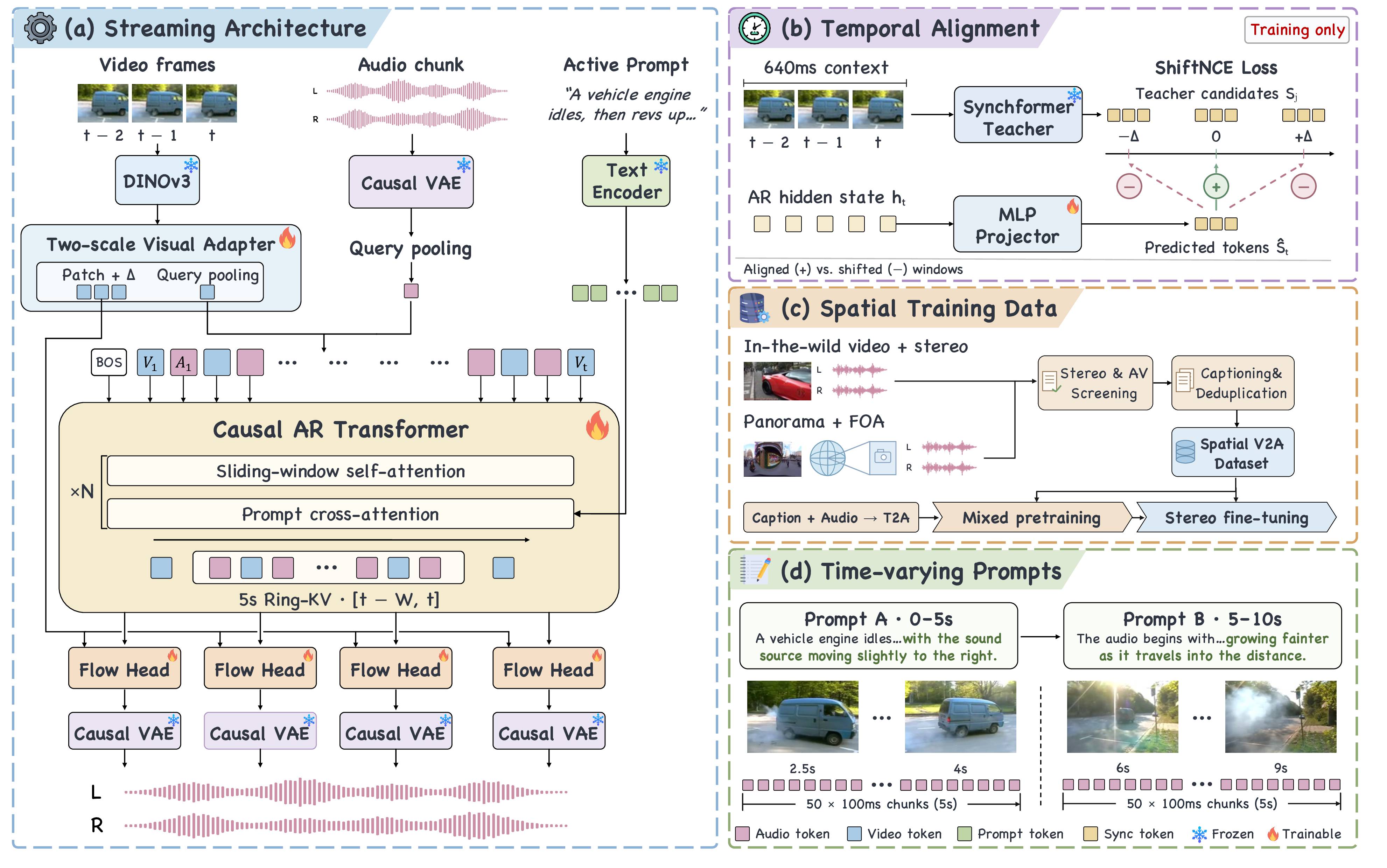
Recent advances in world models have enabled increasingly realistic visual synthesis. However, these generated environments remain largely silent. Bringing sound to world models poses three core challenges: real-time generation to keep pace with interactive video streams, interactive control to respond to mid-stream sound instructions, and spatially aligned stereo to reflect scene geometry and camera motion. To address these demands, we introduce WorldSonus, an interactive video-to-audio framework designed for real-time spatial sound synthesis in world models. For real-time generation, WorldSonus employs a streaming causal autoregressive diffusion architecture that synthesizes audio chunks at a low real-time factor (RTF) of 0.41. For interactive control, we incorporate an audio-centric captioning pipeline with chunk-indexed prompt scheduling, enabling dynamic manipulation of sound events during generation. For spatial alignment, we leverage high-quality stereo supervision curated from diverse stereo and ambisonic data. Extensive experiments demonstrate that while tailored for world models, WorldSonus generalizes effectively to open-domain video-to-audio benchmarks, matching or outperforming state-of-the-art bidirectional models in both acoustic quality and spatial alignment.
Method Overview